
Reflections on peer learning - part 1
What if the way we respond to the crisis is part of the crisis?

Over five months this winter/spring, a group of deep-thinking climate and migration justice folk joined us on a peer learning journey to explore cross-sector collaborations that might catalyse more holistic, justice-oriented strategy and action.
This was not a programme for people already working deeply at the intersections between climate and migration justice. It was not a training, nor a series of academic or theoretical lectures or workshops.
Instead, it was an entry point for those who felt concerned or overwhelmed about injustices that felt outside their immediate remit, but who had appetite to lean into complexity and scope for influence in their organisation’s work. The idea was to see if more cross-sector understanding and collaboration could improve the decisions we make, so that our work towards one kind of justice doesn’t perpetuate other injustices.
The people on the programme have expertise that spans lived experience, community action, cultural work, legal support, campaigning, and policy influence, across climate and migration justice. Their strategies range from legal frameworks to grassroots organising, from policy and advocacy to creative storytelling - read on to see where collaborations took them.
This was a free programme funded by Paul Hamlyn Foundation. You can read more detail of the programme’s approach and aims here.
Naming our conditions
It feels important to mention the timeframe of this programme, as the journey we were on together was accompanied by a global journey very relevant to both climate and migration.
We first met in November 2025 just as the UK government’s asylum reforms made refugee status temporary, and we had our last session in March 2026 a few weeks after these reforms came into effect.
In-between we witnessed a disappointing COP-30, a surge in violent ICE raids and deaths, the rise of the far right having an impact on safety for racialised people, and ongoing destruction and displacement for Palestinians in Gaza. We ended 2025 with widespread recognition that the world is now in a new era of climate extremes, and started 2026 with a US-Israel attack that prompted the current Iran war, causing not only devastating loss of life but also both large-scale displacement and significant emissions and environmental damage.
We mention these occurrences not to be inflammatory or cause overwhelm; we mention them because these were (and are) our reality. In the lineage of Staci K Haines’ work including The Politics of Trauma (which both myself and my co-facilitator Amira Tharani have been influenced by), naming our current conditions is an important first step to finding a way through. It has felt vital throughout this journey towards collaborations to never shy away from the reality of what we are living in, as there’s been increasing recognition that we cannot respond to these crises in ways we are used to. As Dr. Báyò Akómoláfé says, “the times are urgent: let’s slow down”.
This has been particularly important as many of the global events had deeply personal consequences on people in the group. Black and brown participants spoke about tracking these changes in their bodies with spikes in racialization, concerns about safety while mobilising for climate justice and in response to rising far right violence, and in some cases grief through family connection to regions under attack. We cannot ignore that injustices related to both climate breakdown and migration disproportionately impact Black and brown people, and racial justice must be a core thread through any solutions we may find.
How we responded
Overwhelm and urgency were present at the start, given the scale of the issues we were attempting to address. This made it vital to approach our peer learning journey in a way that not only leaned into the reality of our current conditions, but also provided space for care and complexity. Another quote from Dr. Báyò Akómoláfé came to typify much of the learning from the group throughout – “What if the way we respond to the crisis is part of the crisis?”
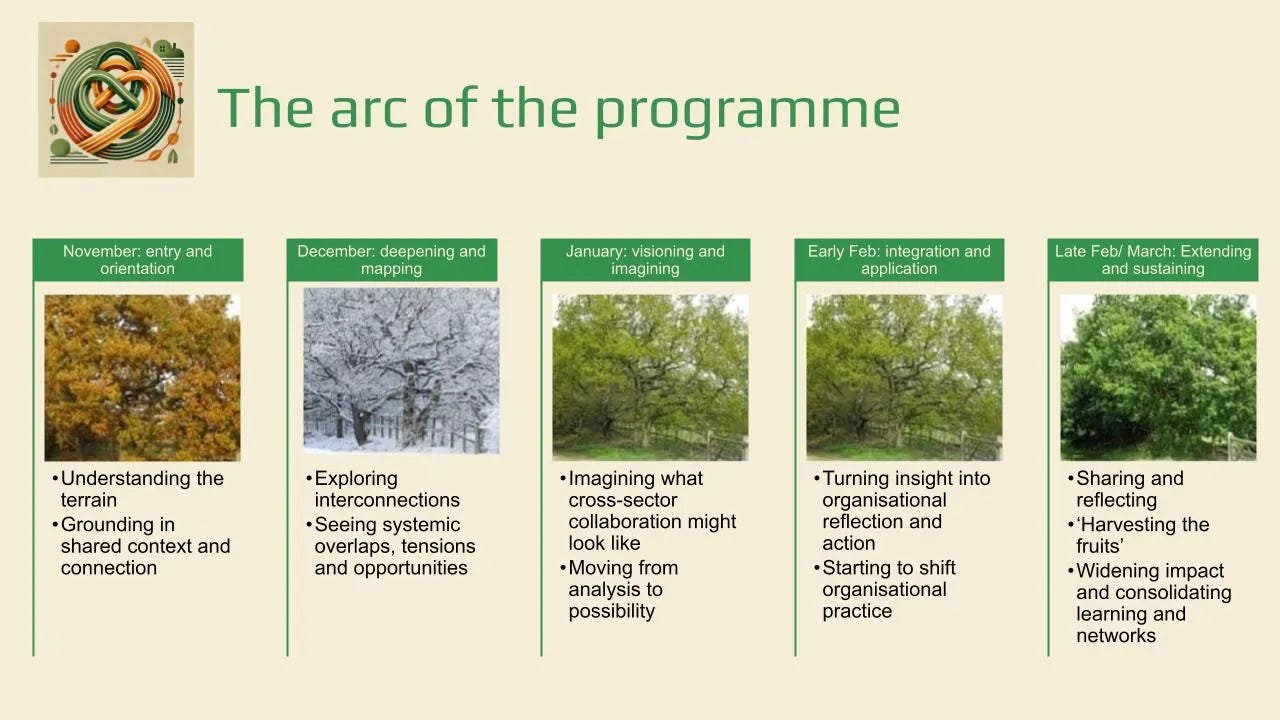
And so, we slowed down. We landed in shared understanding of the context with a session with Fahmida Miah of Climate Outreach, but did not try to rush straight into solutions or collaborations – instead we started with a grounding in knowledge and investment in relationships, and moved through questions towards ideas for action. All this was guided by land and connection. This meant having a seasonal approach to the journey of the programme as a whole to give it shape as we moved from complexity to action. It also meant starting and ending every session with grounding in ourselves, a commitment and connection to each other, and the land we are on.
We started to name some of the tensions we were feeling in this work through a series of Wicked Questions - how can we respond to the interconnectedness of systems of injustice, while being able to do really deep work in one area? How can we be open and inclusive, and also hold strong boundaries around our values and principles? How can we keep space and time to explore, while ensuring that our actions have tangible impact in the shorter term?
It soon became clear through time in conversation that there were two clear yet interconnecting focuses of the group: community-led decision-making, and storytelling + narrative-building. We started organising around two questions:
How might we (as climate, migration and racial justice organisations) collectively shape the narrative around climate migration so that justice is centred in our approach?
How might we (as climate, migration and racial justice organisations) collectively develop community-led approaches to climate migration and adaptation so that justice is centred in our approach?
A strong feeling across both questions was the need to root both narratives and actions in people’s everyday lives, avoiding jargon - making things rooted in human experience. For people embedded deeply in justice-based work, this real-world approach sometimes gets lost amongst the systemic analyses - and we need to be careful to speak about these issues in ways that feel as real and relatable as they are.
One participant said, ‘We can cognitively craft narratives but how do we reach people’s hearts?’ In Minnesota we were seeing people activated led by a deep sense of what’s wrong - how might we sustain this activation in the longer term? Strong, caring communities are sometimes activated by extreme events like Covid or anti-ICE raids, but how do we activate it before things become extreme? How do we activate latent care as a normal day to day way of looking out for each other? How do we build narratives that lift up people’s lived experience, in a way that is about care not using an identity to further an agenda?
These questions led us deeper into collaborative organising around:
Approaches that are rooted in human experience (connecting with people’s hearts and minds, rather than corporate/organisational speak);
Activating strong, connected, caring communities — what are the ingredients to activate latent care before urgent crisis;
Building up the skills to have courageous conversations whilst looking after ourselves — upskilling with care and intention for ourselves and each other;
Centring people’s lived experience in community-led, non-extractive ways to challenge anti-migrant narratives;
Solidarity framing — designing anti-oppression work that both understands how multiple injustices are intertwined, and brings people together;
What can we learn from the joint exploration of regenerative and decolonial frameworks.
In part two of this reflective blog that we’ll share in the coming days, we’ll talk more about what emerged, where we got to and what next. Stay tuned, friends.