
Sharing an Organising (Re)Framework
Reframe, Repair, Reconnect: A Justice-Centred Framework for Climate-Linked Migration

With the latest round of climate diplomacy culminating over at COP30 in Belém, and the UK government descending to new lows with their divisive and cruel migration plans, there is a lot to rage about right now. We are opting to find our own pathways in climate and migrant justice, centring our right to stay, our right to move, and our shared need to belong.
And so… it’s a big moment for our small collaborative as we share with you the outcomes of an 18-month design process through which we have brought folk together to co-create an organising framework for our collective work on climate-linked migration.
Everything is connected to everything else - Barry Commoner
It’s rooted in an understanding that what affects one of us, affects all of us. And when we work in siloes, we act in just one part of a system. This limits our impact or causes consequences elsewhere. Everything is connected, but this can create overwhelm, and even paralyse.
We hope that this framework can help us to open up conversations and navigate our own roles in climate and migrant justice, whatever our background or our work. Each of us has a role to play as we reframe, repair and reconnect. So this framework is for anyone who is interested in exploring climate-linked migration.
But we’ve particularly imagined it being useful for organisations who are interested in learning more about how a climate-migration lens can help them contribute to a green and just transition for us all, collaborating across sectors, from wherever their starting point may be.
We know that frameworks are not for everyone, and we have some other ways that you can get involved via our peer learning programmes and storytelling project. But it felt important to us to create a conceptual container to organise our thinking and as a way to communicate with each other across sectors, inspiring collaborative action.
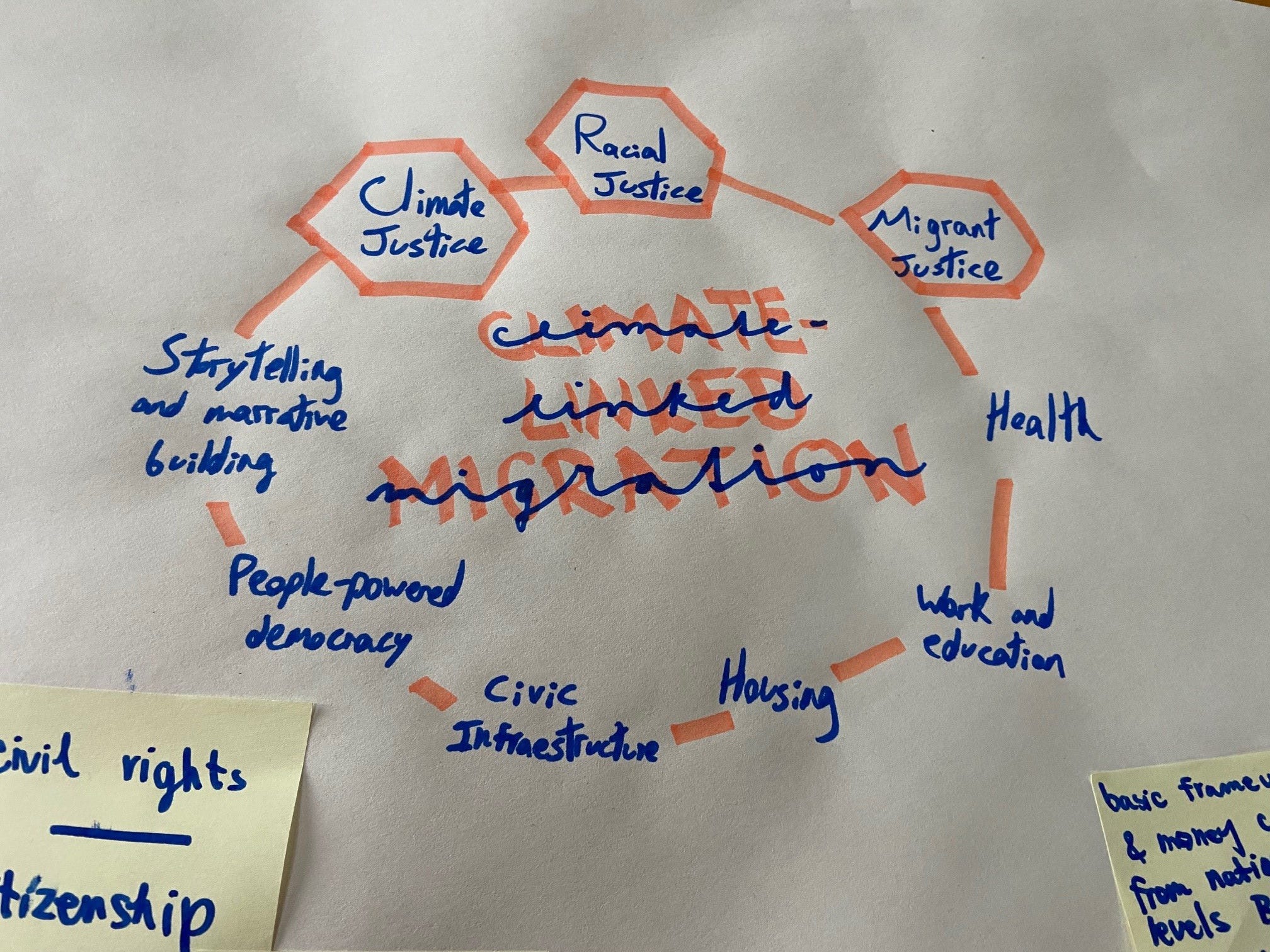
From systems map to organising framework
Systems mapping work was one of the starting points for this project. Yet what began as a few of us doodling on a Miro board grew to encompass the perspectives of more than 80 people aged 16 to 76, studying, working and living across the UK and 20+ countries beyond. We held online workshops which helped us to evolve some systems mapping into a co-created, action-oriented organising framework. We also field-tested an early version of this framework with students of transformative systems change at a coastal campus in Wales, just a few miles from a village at risk of catastrophic flooding due to climate change.
We’ve come to see this framework as an offering to the wider field as we identify leverage points in our systems where we can start to demonstrate new models and practices across diverse domains as well as spotlighting examples of work that are already inspired by a climate-migration lens.
Ultimately, we hope to inspire understanding of the ways in which climate justice, migrant justice and racial justice are deeply interconnected, and to highlight the ways in which our systems, institutions and infrastructure uphold these injustices. We hope to catalyse fresh thinking around how these structures can be reoriented towards a justice-centred approach that supports the ‘right to stay’ and the ‘right to move’ as we experience climate breakdown. And we hope that it will be used to catalyse intersectional collaborations to that end.
Using the Framework
Exploring the framework at your desk - our framework is hosted on our Notion website and is structured for easy navigation if you are seeking to familiarise yourself with the work, and start sharing it with others
Exploring the framework with a group - if you are ready to start interacting with the framework and using it with a group, we have a version of the framework hosted on a Miro board. You can make a copy, experiment, use it to catalyse conversation. You can also use it as a jumping off point for a deep dive into a particular theme or leverage point.
Taking the framework off the page - if you’d like to run a workshop using this framework in person, it’s quite easy to map out the building blocks onto sheets of flip chart paper, just as students did at UWC Atlantic College last year (see pic above from their workshop) then get creative with post-its, sticky dots and marker pens!
What next?
We’d love to see individuals and organisations engaging with the framework, and letting us know how it lands with your teams. We’d really warmly welcome your feedback as we can only improve it and unlock more impact with your help!
Our first engagement working with the complete framework will be at Goldsmiths, University of London, where Anthropology students on the Critical Ecologies module will be joining a workshop that we’re designing to explore climate and migrant justice from a systems perspective.
We’re also speaking to organisations who would like to commission a workshop or learning programme for their own organisation to explore and unpack the framework in their own context as they work to centre climate justice, migrant justice and racial justice in their work. Whether you’re an environmental charity, a housing project, a health service, a green jobs scheme or a community asset builder, we’d love to hear from you!
In the meantime, we’ll be developing some facilitation prompts and exercises to support engagement with the framework and hope to be sharing these as open source materials early next year. You, our lovely Substack subscribers, will be the first to hear when they are ready!
Finally, a shout-out to the Climate and Migration team at Climate Outreach who are hosting an online event on 26th November Local to global: How diaspora communities mobilise climate action, chaired by Fahmida Miah. Click here for info and registration.
This comes against the backdrop of Belém’s COP30, where the slogan “Global Mutirão” has been celebrated (originally from the Tupi-Guarani language), meaning ‘collective efforts’ and encouraging action worldwide.